Research
Find evidence, buyer language, problems, and contradictions.
A business-first guide by Danny Francisco
Start a Business, Find Customers, Deliver the Work, and Grow Before Hiring Employees
Build the capabilities of a small company before you can afford the team.
Learn to direct AI across the work every business must perform while you remain responsible for customers, commitments, money, quality, and final decisions.
No email registration. The companion kit is available directly.
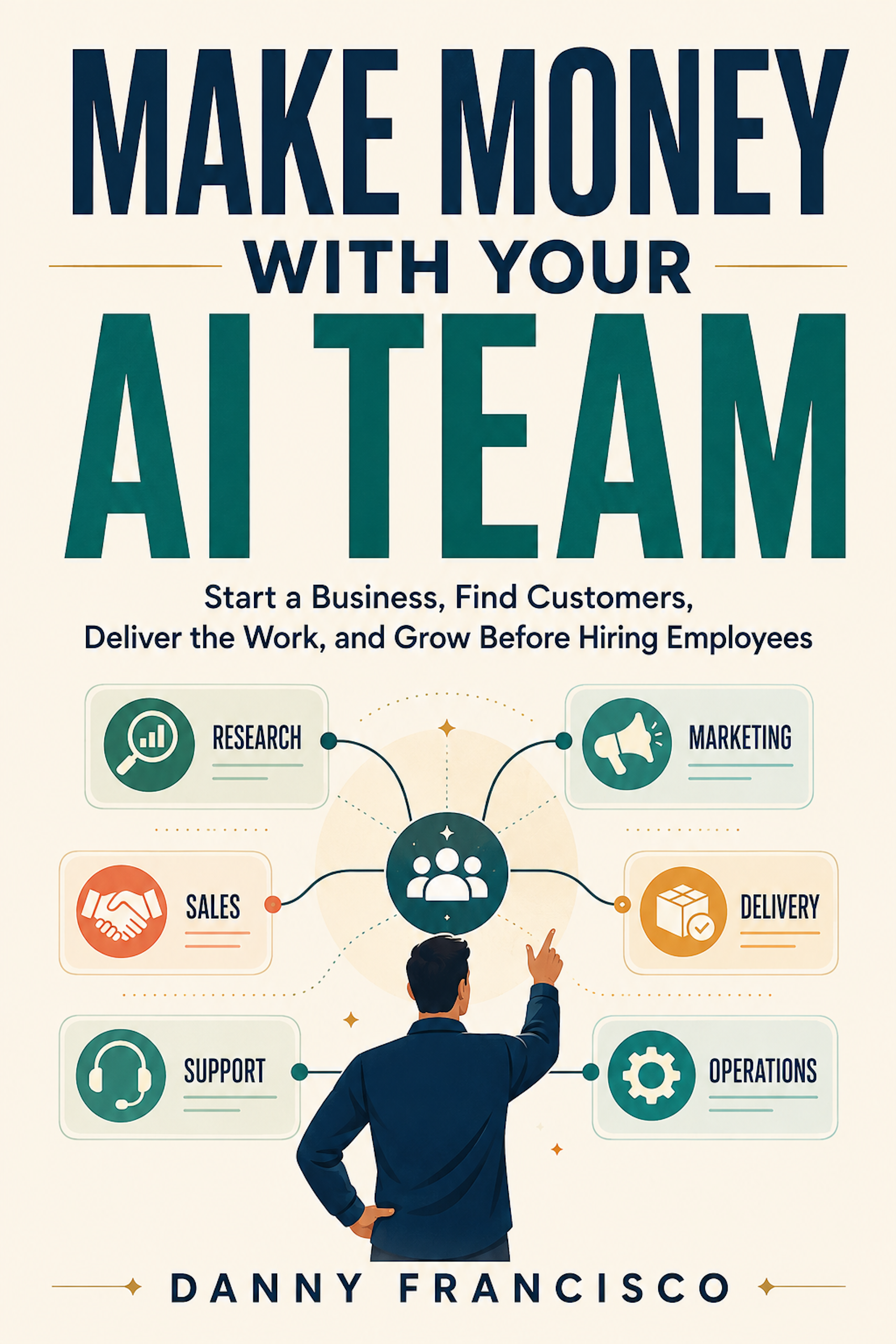
One founder. Six business functions.
AI provides working capacity. You provide judgment, context, approval, and accountability.
Find evidence, buyer language, problems, and contradictions.
Turn approved insight into useful positioning and channel activity.
Prepare prospects, conversations, proposals, and follow-up.
Onboard, produce, verify, revise, and obtain acceptance.
Classify questions, protect scope, and maintain customer trust.
Review cash, capacity, records, priorities, and improvement.
Two ways into the book
Starting a business
For readers turning a skill, product, idea, or body of knowledge into a reachable buyer, a meaningful problem, and a testable offer.
Running a business
For owners who want more capacity across customer acquisition, selling, delivery, support, operations, and e-commerce before hiring employees.
Business progress, not AI theory
The book helps you perform each step, make the decision it requires, and carry useful work forward.
Two complete business routes
Service business
Build offers, start customer conversations, prepare proposals, protect scope, deliver in reviewable stages, manage revisions, obtain acceptance, collect payment, and create reusable delivery assets.
E-commerce
Work through product selection, listings, pricing and economics, acquisition channels, orders, fulfillment, customer support, refunds, inventory, and cash reconciliation.
How the AI team works
Use ChatGPT, Claude, Gemini, or another capable assistant. The method is vendor-neutral and keeps consequential decisions with the founder.
Learn the work before trying to automate it.
Give each role a purpose, input, output, quality check, and handoff.
Supply approved buyer, offer, customer, source, and operating information.
Pass approved work from research through marketing, sales, delivery, support, and review.
Use supported schedules for bounded preparation and reminders.
Add tools only when the task is stable, observable, reversible, and worth repeating.
The complete product package
Direct download. No registration or email collection.
Business first
Questions
No. The book is written for business readers and uses plain-language prompts, roles, records, and review practices.
Yes. The method is vendor-neutral. Features differ by product, account, plan, and region, so the Starter Kit keeps platform-specific setup guidance separate and updateable.
Both. New founders can build a direction, buyer, offer, and first operating path. Existing owners can add capacity across acquisition, sales, delivery, support, operations, and e-commerce.
Yes. It includes a complete e-commerce route covering product evidence, economics, listings, traffic, orders, fulfillment, support, returns, inventory, and cash.
No. You begin with manual prompts and reusable roles. Scheduling and supervised agents come later, with human approval around money, promises, publishing, customer contact, privacy, and consequential decisions.
Editable worksheets, a formula-driven workbook, AI-role blueprints, context templates, prompts, approval patterns, weekly reviews, service and e-commerce examples, trackers, and automation-planning tools.
The companion Starter Kit is available as a direct public download. No email registration is required.
Use the support and updates section on the Starter Kit companion page.
Build the business before you build the payroll